
If I administer naloxone, does that mean I do not need to call 9-1-1?
What is the history of naloxone in Maine?
Are there any legal liabilities for administering naloxone?
What does the medication look like?
Where can I get an overdose response an naloxone administration training?
What is naloxone?
Naloxone is an opioid overdose reversal medication. Naloxone can also reverse overdoses that occur when individuals use opioids in combination with sedatives or stimulants. Naloxone cannot reverse non-opioid overdoses.
If I administer naloxone, does that mean I do not need to call 9-1-1?
***IF SOMEONE IS EXPERIENCING A MEDICAL EMERGENCY, IMMEDIATELY CALL 9-1-1***
Act immediately
- Administer naloxone
- Call 9-1-1 and say, “Someone is unresponsive and not breathing.”
- Be sure to give a specific address and/or description of your location.
Learn more about responding to an opioid overdose
What is the history of naloxone?
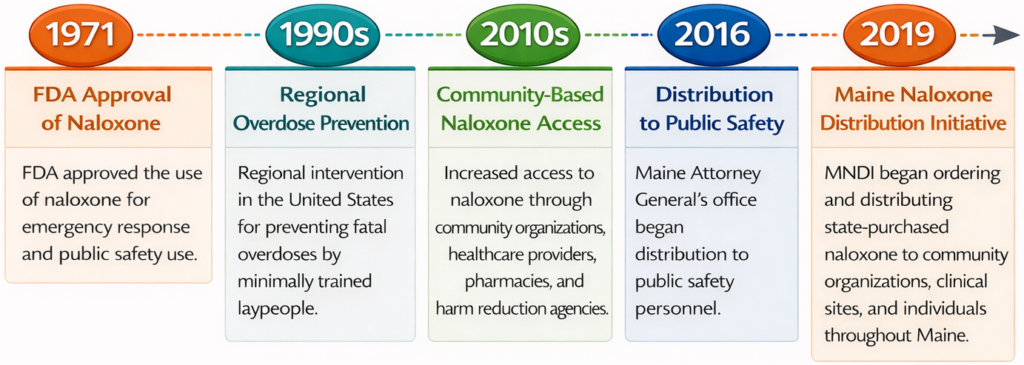
- 1971 – FDA approved the use of naloxone for emergency response and public safety use
- 1990s – Regional intervention in the United States for preventing fatal overdoses by minimally trained laypeople.
- 2010s – Increased access to naloxone through community organizations, healthcare providers, pharmacies, and harm reduction agencies.
- 2016 – The Maine Attorney General’s office began distribution to public safety personnel.
- 2019 – Maine Naloxone Distribution Initiative (MNDI) began ordering and distributing state-purchased naloxone to community organizations, clinical sites, and individuals throughout Maine.
Is naloxone safe?
Naloxone is a safe, non-addictive, prescription, and over-the-counter medication. Naloxone only works if opioids are present in the body. If there are no opioids present, naloxone has no effect, positive or negative.
Is naloxone legal?
Both naloxone nasal spray and intramuscular naloxone are legal in Maine. The passage of LD 994 in 2021 eliminates the crime of illegal possession of hypodermic syringes from state law, making vial and syringe intramuscular naloxone legal to possess.
Are there any legal liabilities for administering naloxone?
The Good Samaritan Law protects a person who, in good faith, seeks medical assistance for a person experiencing a drug-related overdose; is experiencing an overdose and needs medical assistance; and is “rendering aid” at the scene of an overdose. “Rendering aid” means performing any action that involves looking after a person who is experiencing a suspected drug-related overdose.
Read more about Maine’s law regarding naloxone here
What does the medication look like?
Naloxone comes in many preparations, including intranasal, intramuscular, intravenous, auto-injectors, and others. In Maine, State-supplied naloxone typically comes in two preparations: intranasal naloxone kits and intramuscular syringe and vial doses.

Where can I get an overdose response and naloxone administration training?
If you are interested in overdose response and naloxone administration training for yourself, your organization, or your business, please click below.